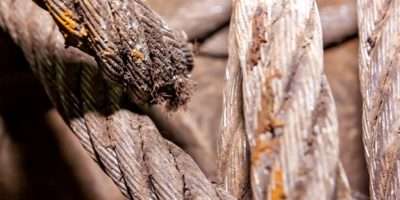
A wire rope grease applicator can improve the consistency of lubricant application, but getting the full benefit still depends on how the equipment is set up and used.
Seal selection, lubricant choice, rope condition and operating setup all influence how effectively lubricant is delivered during each pass. A few consistent setup and maintenance habits can therefore make a significant difference to how repeatable the lubrication process is.
Here are five practical steps to help maintenance teams get more from a wire rope grease applicator.
1. Clean The Rope As Part Of The Process
Removing contamination and built-up lubricant can improve both inspection and subsequent lubrication, but this does not necessarily need to be a separate manual process. Many Viper users fit a Viper Rope Cleaner (VRC) ahead of the lubrication collar so the rope is cleaned immediately before fresh lubricant is applied.
Standard VRCs are available for conventional stranded ropes, while the Viper Smooth Bore Cleaner is designed for rope constructions where the valleys between strands are too shallow for a standard cleaner, including certain non-rotating ropes, ROV cables and ropes with a high number of outer strands.
For maintenance teams that need to clean a rope primarily to support inspection, Viper also offers the VMRCS Manual Rope Cleaner System. It works with standard VRCs and Smooth Bore Cleaners to remove old lubricant and contamination without requiring the lubrication collar to be used at the same time.
This ability to clean and lubricate as part of one maintenance process is one of the practical benefits of the Viper system. A&S describes the Viper range as providing cleaning and lubrication in one process.

2. Match The Seal To Your Rope
Correct seal selection is a key part of setting up a wire rope grease applicator.
The seal needs to match the actual rope diameter and construction closely enough to maintain effective contact around the rope while it passes through the lubricator. Incorrect seal selection can reduce the effectiveness of lubricant delivery by allowing pressure and lubricant to escape around the rope rather than being directed through the seal chamber.
A&S International recommends using the Viper Seal & Scraper Selection Guide to match seals and scrapers to the actual rope size and construction. The guidance also includes different recommendations for compact and multi-strand ropes.
This is particularly important because nominal rope size does not always tell the full story. Measuring the rope itself before selecting seals helps ensure the setup reflects its actual condition.
3. Choose The Right Grease For The Application
The lubricant should be matched to the rope construction and operating environment.
Penetrating products can help carry lubricant towards internal wires and contact points, while coating greases provide a more durable external barrier against moisture and contamination. In some applications, the maintenance strategy may need to balance both functions rather than treating them as completely separate choices.
Among different wire rope lubrication methods, the applicator can only work with the lubricant being fed through it. Correct equipment setup cannot compensate for a grease that is poorly suited to the rope, loading conditions or environment.
4. Set The Equipment Up For The Rope And Lubricant
Follow the operating guidance for the specific Viper model, lubricant and rope being used.
Rope speed, pump output and seal selection all influence how lubricant is delivered, and the correct setup will vary with rope diameter, lubricant characteristics and application.
The Viper Wire Rope Lubricator range can operate at lubrication speeds of up to 2,000 metres per hour, but maximum speed should not automatically be treated as the correct setting for every rope or lubricant. A&S also provides specific operating manuals and product guidance for the Mini, Mid and Maxi systems.
On larger ropes, dwell time can also influence penetration. The Viper Maxi MKII technical information explains how its longer seal arrangement increases lubricant dwell time while the system maintains pressure around the rope.
5. Inspect, Record And Repeat
After each lubrication cycle, inspect the seals, scrapers and fittings for wear and check that lubricant coverage is consistent along the rope.
Maintenance teams should also record the completed lubrication activity within their existing maintenance system. A clear history of when the rope was lubricated, which product was used and any condition observations can help with future planning and provide continuity between operators and shifts.
Where the rope forms part of lifting equipment, routine lubrication records should not be confused with statutory LOLER records. HSE guidance on LOLER requires records of statutory thorough examinations, while maintenance remains a separate requirement under PUWER.
HSE also explains that a thorough examination is a systematic inspection carried out by a competent person and subject to specific reporting and record-keeping requirements.
Bringing It All Together
Among different wire rope lubrication methods, getting more consistent results from a wire rope grease applicator depends on following a repeatable setup and maintenance process:
- Select the appropriate Viper cleaning method where contamination or built-up lubricant needs to be removed before the rope enters the lubrication collar
- Match the seals and scrapers to the actual rope diameter and construction
- Select a lubricant suited to the rope and operating environment
- Follow the correct operating guidance for speed, pump output and setup
- Inspect the equipment after use and record completed maintenance
None of these steps is particularly complicated on its own, but together they help make the lubrication process more repeatable and reduce variation between maintenance cycles.
Why The Setup Matters
A consistent setup and lubrication routine can help maintenance teams make better use of the applicator and reduce variation between lubrication cycles.
A wire rope greasing machine provides the delivery method, but correct seals, lubricant selection and operating setup still matter to the result. A&S states that Viper systems can significantly reduce the labour involved in re-lubrication compared with manual methods while providing more consistent application.
Common Mistakes Worth Watching For
Common setup and maintenance mistakes can include continuing to use worn or incorrectly sized seals, rushing the lubrication pass, using a lubricant that is poorly matched to the application, over-lubricating the rope or failing to record completed maintenance.
Applying more lubricant than the rope requires can create unnecessary mess, increase lubricant consumption and increase the potential for excess grease to enter the surrounding environment. Correct setup should therefore aim to deliver the required coverage without unnecessary lubricant use.
These issues may seem minor individually, but each can reduce the consistency of the process and make it more difficult for maintenance teams to understand how the rope has been treated over time.
Training New Operators Properly
Operator training should cover seal selection, equipment setup, lubricant choice, safe operation and routine inspection.
Providing a defined operating procedure helps make the lubrication process more repeatable between operators and shifts, particularly where a wire rope greasing machine is used across different rope sizes or applications.
A&S International also provides access to technical guidance, operating manuals and product support for the Viper range through its Viper Wire Rope Lubricator resources.
Make Sure Your Setup Is Delivering Consistent Lubrication
If you are unsure whether your current wire rope grease applicator setup is delivering consistent lubrication, request a quote for the Viper Wire Rope Lubricator range and discuss the right configuration for your rope diameter, lubricant and operating conditions.