Wire rope corrosion can develop externally, internally or in both areas at the same time. Internal deterioration is particularly difficult to assess because a rope may show limited outward evidence while moisture and corrosive contaminants affect wires beneath the surface.
For maintenance teams, understanding how wire rope corrosion develops is important because surface appearance alone cannot always reveal the full condition of the rope. Inspection, operating environment and lubrication history all need to be considered when assessing deterioration.
Where Wire Rope Corrosion Develops
Wire rope corrosion can begin wherever moisture and corrosive contaminants reach unprotected steel.
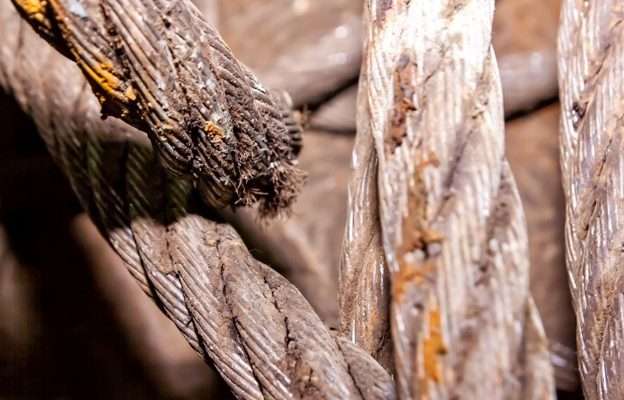
External corrosion may be visible as rust or pitting, while internal corrosion can develop between individual wires and strands where it is more difficult to detect. Moisture retained within the rope construction can increase this risk, particularly where lubrication has deteriorated or does not provide sufficient protection.
HSE guidance on wire rope condition highlights warning signs that can include red dust or rouge, local reductions in rope diameter, displaced strands and localised deformation.
These indicators should prompt closer examination rather than automatically being treated as cosmetic surface deterioration.
Why Some Environments Increase Corrosion Risk
Marine, coastal and chemically aggressive environments can increase the likelihood of wire rope corrosion because ropes may be repeatedly exposed to moisture, salts and contaminants.
Repeated wetting, salt exposure and inadequate lubrication can contribute to both external and internal deterioration, particularly where moisture remains trapped within the rope construction.
For this reason, a rope working in a corrosive environment may require a different maintenance and lubrication approach from one operating indoors under relatively dry, controlled conditions.
What Corrosion Can Do To Rope Strength
Corrosion can reduce the effective metallic area of individual wires and create localised pitting that increases stress concentration.
As the condition progresses, deterioration can affect the rope’s ability to perform safely under load. External appearance alone may not reveal the full extent of internal corrosion or the reduction in metallic area.
Corrosion is also only one of several wire rope failure causes that maintenance teams should consider. Fatigue, wear, mechanical damage, broken wires, poor lubrication and unsuitable operating conditions can all contribute to deterioration.
That is why corrosion needs to be assessed as part of the rope’s overall condition rather than as an isolated surface issue.
Why Corrosion Is A Compliance Issue As Well As A Maintenance One
Where a wire rope forms part of lifting equipment, the Lifting Operations and Lifting Equipment Regulations 1998 (LOLER) may require statutory thorough examination by a competent person where deterioration could result in danger.
HSE also makes clear that LOLER builds on wider duties under PUWER relating to the suitability, inspection and maintenance of work equipment.
Routine lubrication should not be confused with a statutory thorough examination. Lubrication records can support a site’s wider maintenance history, but they are separate from the examination and record-keeping requirements that apply under LOLER.
For maintenance teams, the practical point is that corrosion protection, routine maintenance and statutory examination all have different roles in keeping lifting equipment safe.
Reading The Warning Signs Correctly
Visible rust does not automatically reveal how much internal deterioration has occurred, but it should not be ignored.
Useful points to consider include:
- Surface corrosion may justify closer inspection even where the rope otherwise appears serviceable
- Red dust or rouge can be an indication that internal deterioration needs further investigation
- Local diameter reduction, displaced strands or stiffness can indicate more significant deterioration
- Ropes operating in wet, marine or chemically aggressive environments may require additional attention because exposure continues between scheduled examinations
Corrosion is one of several wire rope failure causes, so maintenance teams should also consider wear, broken wires, fatigue and mechanical damage when assessing rope condition.
Why Lubrication Matters
Lubricating wire rope with a suitable product is an important part of reducing friction and protecting internal and external wires against corrosion.
HSE guidance identifies several important characteristics of wire rope lubricants, including corrosion protection, water repellence, friction reduction and sufficient penetration to replace lubricant that may have been lost from inside the rope.
The right lubricant and application method depend on the rope construction, operating environment and maintenance requirements. Applying a suitable product consistently can help maintain protection between inspections, but lubrication should complement inspection rather than replace it.
The application method also plays an important role in effective corrosion protection. The Viper Wire Rope Lubricator provides a controlled method of applying wire rope grease, helping achieve consistent coverage and supporting lubricant penetration into the rope’s internal structure. Compared with manual application, it can help reduce lubricant waste and operator exposure during maintenance. When used with a suitable penetrating grease, such as MAK LUBES ML200, it supports effective lubrication of internal and external wires, particularly for ropes operating in demanding environments.
Why Inspection Alone Cannot Tell The Whole Story
Visual inspection remains essential, but internal deterioration can be difficult to assess from surface condition alone.
That is why rope condition, maintenance history, operating environment and any relevant supplementary examination methods need to be considered together.
For ropes working in demanding conditions, lubricating wire rope should form part of a planned maintenance approach rather than being carried out only when visible rust or dryness appears.
Maintenance between scheduled examinations is particularly important because environmental exposure continues throughout the service interval.
Protection For Different Wire Rope Requirements
A&S International supplies the MAK LUBES wire rope lubricant range, including penetrating and coating greases designed for different maintenance requirements.
For example, ML200 Wire Rope Penetrating Grease is formulated to penetrate into the rope while providing water resistance and protection against wear, rust and corrosion.
By contrast, ML221 Wire Rope Coating Grease creates a water-resistant external coating designed to protect the rope surface against corrosion and resist wash-off.
A&S’s marine-sector product information also includes ML253 Ecology EAL Wire Rope Grease for applications where environmental performance is an important consideration.
A&S International also supplies the Viper Wire Rope Lubricator, allowing maintenance teams to combine suitable MAK LUBES greases with a dedicated application system for effective wire rope maintenance.
The right choice depends on the rope construction, operating environment and whether the maintenance requirement calls for internal penetration, external protection or a combination of both.
Build Corrosion Protection Into Routine Maintenance
Wire rope corrosion does not always develop in a way that is obvious from the outside. A planned approach combining suitable lubrication, condition monitoring and appropriate examination gives maintenance teams a stronger basis for managing deterioration before it becomes a wider reliability or safety issue.
Contact A&S International to discuss the MAK LUBES wire rope grease range and Viper Wire Rope Lubricator, and find the right combination of corrosion protection, lubricant penetration and application method for your equipment and operating environment.
Image Source: Envato